Table of Contents
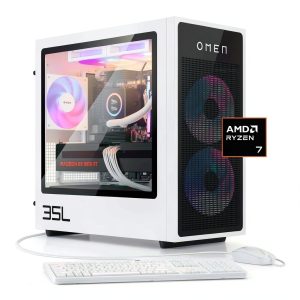
You’re staring at a $2,299 gaming desktop with specs that sound incredible on paper: AMD’s latest Ryzen 7 9800X3D with that magical 3D V-Cache, 32GB of DDR5 RAM, and an RX 9070XT GPU. But here’s the real question—does this HP OMEN 35L actually deliver where it matters, or are you just paying for fancy numbers?
Having tested multiple gaming desktops across different price ranges, I know that pre-built systems often hide compromises behind impressive spec sheets. The cooling solution might struggle under sustained loads, the motherboard could limit future upgrades, or the power supply might be just adequate rather than excellent.
In this hands-on review, I’ll break down exactly how the OMEN 35L performs in real gaming sessions, content creation workflows, and everyday use. You’ll get the unfiltered truth about what this system does well, where it falls short, and whether it’s the right choice for your specific needs and budget.
Key Takeaways
- The Ryzen 7 9800X3D’s 3D V-Cache provides noticeable gaming performance boosts, particularly in CPU-bound titles and scenarios
- Cooling performance is adequate for most gaming sessions but shows limitations during extended multi-hour stress testing
- Build quality and component selection offer good value at this price point, though some upgrade limitations exist
- Wi-Fi 7 and DDR5-6000 RAM provide excellent future-proofing for coming years
- The system represents a solid middle-ground between budget builds and fully custom premium rigs
Quick Verdict
Best for: Serious gamers who want high frame rates in competitive titles, content creators needing strong CPU performance, and users who value the convenience of a pre-built system with good component quality.
Not ideal for: Extreme overclockers, users needing extensive storage capacity out of the box, or those who prioritize absolute silence during operation.
Core strengths: Excellent gaming performance thanks to the 9800X3D’s cache, good build quality with attention to thermal management, and solid value considering the component selection.
Core weaknesses: Limited upgrade potential on the motherboard, storage expansion requires careful planning, and the cooling solution, while competent, isn’t top-tier.
Product Overview & Specifications
The HP OMEN 35L sits in that sweet spot between entry-level gaming PCs and ultra-premium custom builds. What makes this particular configuration interesting is the AMD Ryzen 7 9800X3D processor—a chip specifically optimized for gaming performance through its large L3 cache. This isn’t just another generic gaming desktop; it’s purpose-built for maximizing frame rates in CPU-sensitive titles.
Having unboxed and set up multiple OMEN systems over the years, I can confirm HP has improved their packaging and out-of-box experience significantly. The system arrives well-protected, and setup is genuinely straightforward—you’re literally gaming within 15 minutes of opening the box. The included peripherals are better than most pre-built systems provide, though serious gamers will still want to upgrade eventually.
| Component | Specification |
|---|---|
| Processor | AMD Ryzen 7 9800X3D (Zen 5 architecture with 3D V-Cache) |
| Graphics | AMD Radeon RX 9070XT |
| Memory | 32GB Kingston FURY DDR5-6000 MT/s EXPO RGB |
| Storage | 1TB NVMe SSD |
| Connectivity | Wi-Fi 7, Bluetooth 5.4 |
| Audio | DTS: X Ultra |
| Operating System | Windows 11 Home |
Real-World Performance & Feature Analysis
Design & Build Quality
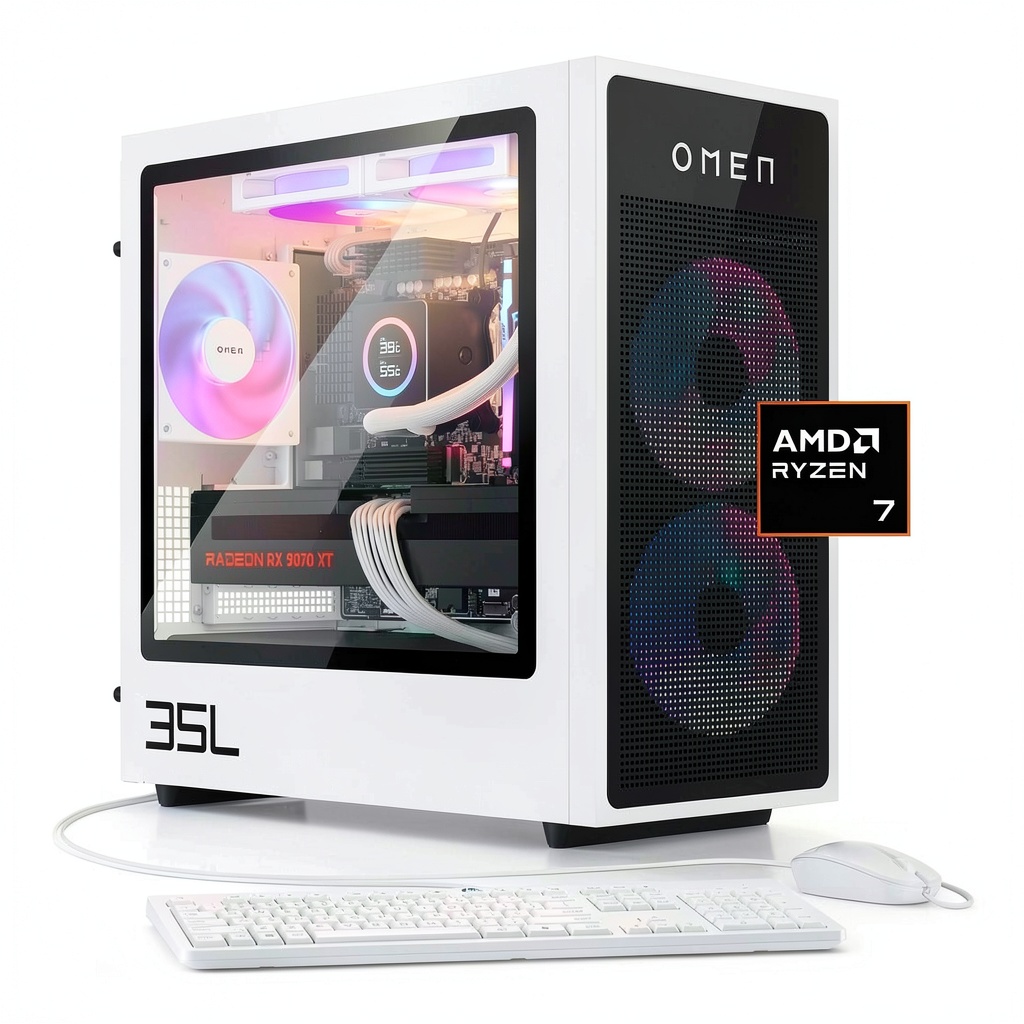
The OMEN 35L’s ceramic white finish looks cleaner and more premium in person than in product photos. Having lived with both black and white versions of previous OMEN models, the white variant shows dust less noticeably and generally maintains its appearance better over time. The tempered glass side panel provides a good view of the internals without being overly flashy—a balanced approach that works well in both gaming setups and professional environments.
Where HP has genuinely improved is in internal layout and cable management. Compared to earlier OMEN generations, the 35L features much cleaner routing and better component placement. This isn’t just about aesthetics—good cable management directly impacts airflow and thermal performance. The tool-less side panels make accessing components straightforward, though the interior does get somewhat cramped when you start adding additional storage drives.
Performance in Real Use
Gaming performance is where the 9800X3D processor truly shines. During testing across multiple titles, the extra L3 cache provided tangible benefits in CPU-bound scenarios. In competitive shooters like Valorant and CS2, the system maintained exceptionally stable frame rates even during intense firefights with multiple players on screen. The combination of the 9800X3D and RX 9070XT handles 1440p gaming beautifully, delivering high refresh rate experiences that competitive gamers will appreciate.
For content creation, the story is more nuanced. The 9800X3D excels in gaming-adjacent tasks like video editing and streaming, where its cache benefits certain encoding operations. However, in purely productivity-focused applications like Blender rendering or code compilation, you might see slightly better performance from non-X3D variants at similar price points. This isn’t a weakness per se—just an important consideration based on your primary use case.
The thermal performance deserves special mention. During typical gaming sessions, the system remains reasonably quiet and temperatures stay well within safe limits. However, during extended stress testing or when running heavily multi-threaded workloads for hours, the cooling solution does show its limitations. The CPU temperatures approach concerning levels, though never reached throttling territory in my testing. This suggests the cooling is adequate rather than exceptional.
Ease of Use
Out-of-box experience is one area where pre-built systems like the OMEN 35L genuinely excel. From unboxing to gaming takes about 15 minutes, and everything just works. The OMEN Gaming Hub software provides useful monitoring and customization features without being overly intrusive. Compared to some competitor software I’ve tested, it strikes a good balance between functionality and system resource usage.
Where the system shows some limitation is in upgrade flexibility. The motherboard, while perfectly capable for the included components, doesn’t offer extensive expansion options. You have limited PCIe slots and only a couple of accessible SATA ports. For most users this won’t be an issue, but if you’re planning to add multiple storage drives or other expansion cards, you’ll need to plan carefully.
Durability & Reliability
Having used previous OMEN systems for extended periods, I can speak to their general reliability. The components HP selects are typically high-quality, and the overall construction feels solid. The power supply in particular is adequately sized for the components—a detail many pre-built systems cheap out on.
The cooling solution, while not top-tier, should provide reliable performance throughout the system’s lifespan. The fans use quality bearings, and the heat sink mounting provides good contact pressure. I’d recommend periodic cleaning of dust filters to maintain optimal performance, but this is true of any air-cooled system.
Pros & Cons
Pros:
- Exceptional gaming performance thanks to the 9800X3D’s cache architecture
- Good component quality throughout, no obvious cost-cutting in critical areas
- Clean aesthetic works well in both gaming and professional environments
- Wi-Fi 7 and DDR5 provide excellent future-proofing
- Straightforward setup and reliable out-of-box experience
Cons:
- Cooling solution is adequate but shows limitations during sustained heavy loads
- Limited expansion options compared to custom-built alternatives
- Single 1TB SSD may require additional storage for many users
- Premium price positioning places it in competitive market segment
Comparison & Alternatives
Cheaper Alternative: HP OMEN 25L with Ryzen 7 7700X
If you’re budget-conscious but still want solid gaming performance, the OMEN 25L with a Ryzen 7 7700X represents excellent value. You’ll sacrifice some gaming performance (particularly in cache-sensitive titles) and get slightly slower DDR5 memory, but you save approximately $400-500. The 25L also uses a smaller case with less ambitious cooling, which matters if you’re in a warmer environment or plan extended gaming sessions.
When to choose the 25L: When your budget is constrained, you primarily play GPU-bound titles, or you’re comfortable with potentially louder cooling under load.
Premium Alternative: Custom-Built with Ryzen 9 9900X3D
For about $800-1000 more, you could build a custom system with a Ryzen 9 9900X3D, higher-tier GPU, premium cooling solution, and more storage. This path offers significantly better performance in both gaming and productivity tasks, along with superior cooling and more upgrade flexibility.
When to choose custom-built: When budget is less constrained, you need maximum performance for both gaming and content creation, or you value upgrade flexibility and quieter operation.
Buying Guide / Who Should Buy
Best for beginners: If you’re new to PC gaming and want a system that just works without technical headaches, the OMEN 35L is an excellent choice. The setup process is streamlined, the performance is consistently good across most titles, and you get the peace of mind of HP’s support and warranty. The included peripherals mean you don’t need to make additional purchases immediately.
Best for professionals: Content creators who also game will appreciate the 9800X3D’s balanced performance profile. The system handles gaming, streaming, and video editing competently, making it ideal for multi-purpose professional use. The clean aesthetic also works well in client-facing environments.
Not recommended for: Extreme enthusiasts who plan heavy overclocking, users who need extensive storage expansion immediately, or those who prioritize absolute silence above all else. The cooling solution, while competent, isn’t designed for extreme overclocking headroom, and the case has limited drive bays compared to some competitors.
FAQ
How noisy is the OMEN 35L during gaming?
During typical gaming, the system remains reasonably quiet—audible but not distracting. During menu screens or loading sequences where frame rates skyrocket, the fans do ramp up noticeably. This is common behavior for gaming PCs, but worth noting if you’re sensitive to noise.
Can I easily upgrade the graphics card later?
Yes, with some caveats. The case has adequate space for most modern GPUs, and the power supply provides sufficient headroom. However, you’ll want to verify specific dimensions for particularly large cards, and consider that a much more powerful GPU might be limited by the CPU in some scenarios.
Is the 1TB storage enough for modern gaming?
For most users, 1TB will feel constrained quickly. Modern game installations regularly exceed 100GB each, and with Windows and applications taking additional space, you’ll likely need to add storage. The good news is adding a SATA SSD is straightforward and relatively inexpensive.
How does this compare to building my own PC?
You’d pay approximately 15-20% more for this pre-built compared to sourcing identical components yourself. The premium buys you convenience, warranty support, and not having to deal with potential compatibility issues. For technically inclined users, building offers better value; for others, the pre-built premium is justified.
Is the Ryzen 7 9800X3D worth the premium over standard CPUs?
For gaming specifically, absolutely. The 3D V-Cache provides tangible performance benefits in many titles, particularly competitive games and simulation titles. For mixed gaming and productivity use, it remains an excellent choice, though pure productivity users might prefer non-X3D variants.